Statistics Training Material

TOOLKITs

Guiding countries in their data collection is particularly necessary as to date a limited number of countries report national data that are internationally comparable data on waste statistics. Measuring waste statistics is an important step towards addressing the waste challenge since statistics help to evaluate developments over time, set and assess targets, and identify best practices in policies.

Better waste data will help track the global target of the Sustainable Development Goals (SDG), in particular SDG 12, to “ensure sustainable consumption and production patterns,” as well as other SDGs. E-waste statistics are in particular relevant for SDG 12.4.2 on hazardous waste and SDG 12.5.1 on the national recycling rate. In addition, these datasets are becoming of increasing importance for global treaties, such as Minamata, Basel Conventions, and the upcoming Plastic Treaty.

UNITAR-SCYCLE has co-developed toolkits and methodologies to support countries tracking their waste management.

The Urban Mine Platform

The Urban Mine Platform offers a new way to explore the availability and recoverability of secondary and critical raw materials in Europe. Covering seven key waste streams – batteries, construction and demolition waste, wind turbines, end-of-life vehicles, mining waste, slags and ashes, and WEEE – the platform provides clear, structured data and projections to 2050.

(You will be redirected to an external website)

Methods

E-waste Statistics Guidelines Third Edition 2026: strengthening global measurement and reporting of e-waste statistics
E-waste-Statistics-Guidelines-Third-Edition.pdf
also available on https://scycle.info

Read more about the previous edition of the E-waste Statistics Guidelines, Second Edition 2018.
Partnership for Measuring ICT for Development guidelines on e-waste statistics:

E-waste-statistics-guidelines-on-classification-reporting-and-indicators.pdf
also available on https://globalewaste.org

UNECE Framework on Waste Statistics (pdf):
Conference of European Statisticians Framework on Waste Statistics | UNECE
also available on https://unece.org

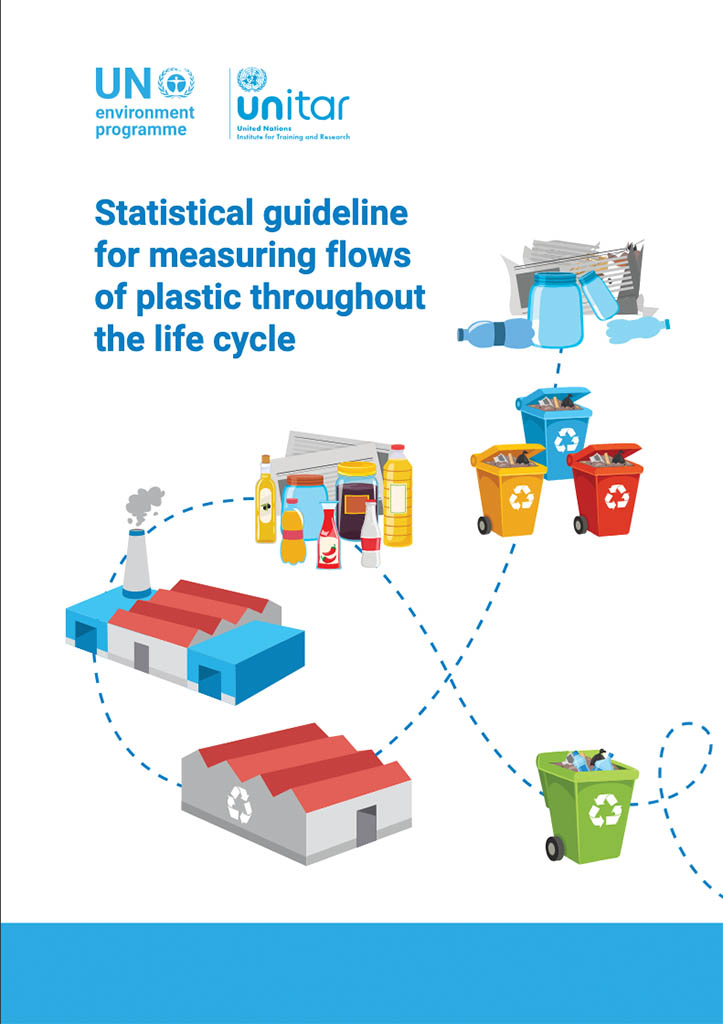
UNEP and UNITAR Statistical Guideline for Measuring Flows of Plastic Throughout the Lifecycle:
Guideline on Plastic Statistics 
Also available on https://scycle.info

Online Training

UNCC LEARN TRAINING OF UNITAR:  How to prevent e-waste?
(https://unccelearn.org/)

Read more here on academy-ce.info

An introduction to the e-waste challenge | ITU Academy
(https://academy.itu.int/training-courses/)

Calculation Tools

E-waste Statistics Toolkits

The “E-Waste Collected Calculation Tool”:

an interactive tool for setting e-waste collection targets to explore the resulting amounts of managed and unmanaged waste from 2020 to 2050.

  • Excel tool: ENRU
  • Manual: EN + RU
  • Countries: Kazakhstan, Kyrgyzstan, Uzbekistan and Tajikistan

E-waste Generation Calculation Tool:

to perform e-waste generation calculations using placed on market input from other placed on market tools per country.

Customized E-waste generation tool for European Union Countries:

pre-filled and customized toolkit developed for the European Union

EEE POM Calculation Tool:

to perform placed on market calculations using trade statistics and production statistics per country. Output can be inserted in the “E-waste generation Calculation Tool”.

PV Panel POM Calculation Tool:

to perform placed on market calculations using installed capacity in MW per country. Output can be inserted in the “E-waste generation Calculation Tool”

  • Excel tool: EN
  • Manual: EN

Plastic Statistics Toolkit

Plastic Put on Market (POM) Calculation Tool (P1, P2, P3, P5, P7 and P8):

to perform placed on market calculations using trade and production statistics per country.

The tool covers the following Plastic-KEY Groups:
P1
Packaging, P2 Transport, P3 Building and Construction, P5 Consumer and Institutional Products, P7 Apparel and Textile Furnishing Articles, and P8 Other.

The output can be used as input for the Plastic Waste Generated Calculation Tool.

  • Excel tool: EN

Plastic Waste Generation Calculation Tools

To perform plastic waste generation calculations using placed on market data as input.

Plastic Waste Generated Calculation Tool (P1, P2, P3, P5, P7 and P8)

This tool estimates plastic waste generated in the following Plastic-KEY Groups:
P1 Packaging, P2 Transport, P3 Building and Construction, P5 Consumer and Institutional Products, P7 Apparel and Textile Furnishing Articles, and P8 Other.

The input data for this tool is generated by the Plastic POM Calculation Tool.

  • Excel tool: EN 

Plastic in E-waste Generation (P4):

This tool estimates plastic waste generated in the P4 Electrical and Electronic Equipment Plastic-KEY Group.

The input data for this tool is generated by the EEE POM Calculation Tool.

Manual for Plastic POM and Plastic Waste Generated Calculation Tools:

This manual provides guidance for both the Plastic POM Calculation Tool and the Plastic Waste Generated Calculation Tool (P1, P2, P3, P5, P7 and P8).