Statistics Training Material

TOOLKITs

Guiding countries in their data collection is particularly necessary as to date a limited number of countries report national data that are internationally comparable data on waste statistics. Measuring waste statistics is an important step towards addressing the waste challenge since statistics help to evaluate developments over time, set and assess targets, and identify best practices in policies.

Better waste data will help track the global target of the Sustainable Development Goals (SDG), in particular SDG 12, to “ensure sustainable consumption and production patterns,” as well as other SDGs. E-waste statistics are in particular relevant for SDG 12.4.2 on hazardous waste and SDG 12.5.1 on the national recycling rate. In addition, these datasets are becoming of increasing importance for global treaties, such as Minamata, Basel Conventions, and the upcoming Plastic Treaty.

UNITAR-SCYCLE has co-developed toolkits and methodologies to support countries tracking their waste management.

Methods

Partnership for Measuring ICT for Development guidelines on e-waste statistics:
E-waste-statistics-guidelines-on-classification-reporting-and-indicators.pdf
also available on https://globalewaste.org

UNECE Framework on Waste Statistics (pdf):
Conference of European Statisticians Framework on Waste Statistics | UNECE
also available on https://unece.org

Basel Convention on Inventory for Plastic Waste:
On-going: Statistical guidelines for plastic along the lifecycle with collaboration with UNEP

coming soon

Online Training

UNCC LEARN TRAINING OF UNITAR:  How to prevent e-waste?
(https://unccelearn.org/)

Read more here on academy-ce.info

An introduction to the e-waste challenge | ITU Academy
(https://academy.itu.int/training-courses/)

Calculation Tools

E-waste Statistic Toolkit

The “E-Waste Collected Calculation Tool”:

an interactive tool for setting e-waste collection targets to explore the resulting amounts of managed and unmanaged waste from 2020 to 2050.

  • Excel tool: ENRU
  • Manual: EN + RU
  • Countries: Kazakhstan, Kyrgyzstan, Uzbekistan and Tajikistan

E-waste Generation Calculation Tool:

to perform e-waste generation calculations using placed on market input from other placed on market tools per country.

Customized E-waste generation tool for European Union Countries:

pre-filled and customized toolkit developed for the European Union

EEE POM Calculation Tool:

to perform placed on market calculations using trade statistics and production statistics per country. Output can be inserted in the “E-waste generation Calculation Tool”.

PV Panel POM Calculation Tool:

to perform placed on market calculations using installed capacity in MW per country. Output can be inserted in the “E-waste generation Calculation Tool”

  • Excel tool: EN
  • Manual: EN

Plastic Statistic Toolkit

Plastic Put on Market Calculation Tool:

to perform placed on market calculations using trade statistics and production statistics per country.
Output can be inserted in the “Plastic Waste generation Calculation Tool” (Update February 2025).

Plastic Waste Generated Tool:

to perform plastic waste generated calculations using placed on market input from other placed on market tools per country (Update February 2025).

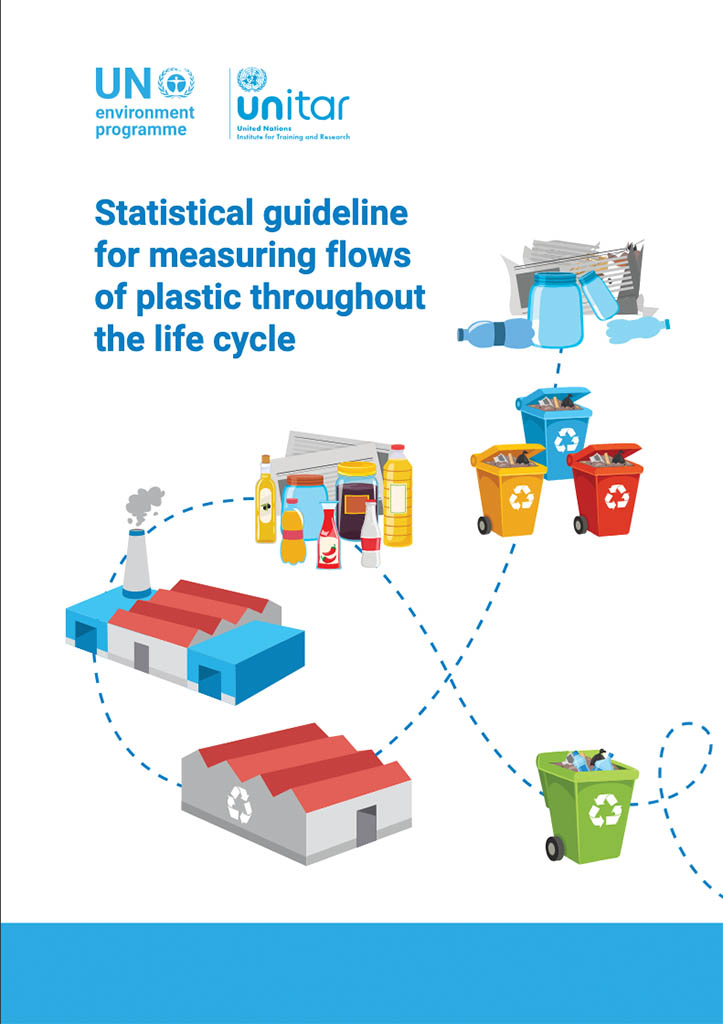
UNEP and UNITAR Statistical Guideline

for Measuring Flows of Plastic throughout the Life Cycle.

With the continued increase in the production and consumption of plastics in recent decades, combined with a predominantly linear plastic economy and insufficient waste management, plastic pollution has become a global concern. Monitoring this issue is therefore essential. At the same time, producing statistics on plastics across the entire life cycle presents multiple challenges. Clear scoping and consistent definitions of plastics across society are necessary to support the development of robust statistics.

Experts from the United Nations Environment Programme (UNEP) and the United Nations Institute for Training and Research (UNITAR), in collaboration and consultation with experts from other international organisations, national statistical offices, relevant ministries, academia, research institutes, and other entities of UN Member States, have developed the Statistical Guideline for Measuring Flows of Plastic throughout the Life Cycle. The Guideline proposes the boundaries of the plastic life cycle, defines key terms and concepts, and details the main elements for accounting for the production, trade, consumption, and waste of plastics.

In developing the Statistical Guideline have been developed aligning to internationally agreed statistical standards, classifications, methodologies, and available data sources, with the aim of presenting a comprehensive picture of plastic flows throughout the life cycle. The Guideline is intended to provide substantial support to statistical offices and other relevant organisations responsible for producing statistics on plastics at the national, regional, and global levels.

This Statistical Guideline represents a first step in addressing the absence of a detailed, globally agreed methodology for measuring plastic flows. Some aspects may require further discussion and refinement in future versions. Its application by statisticians and other relevant experts at the national level is expected to result in high-quality statistics on plastics that are comparable across national, regional, and global levels. These statistics will, in turn, support policymaking on strategically important issues, including, but not limited to, the 2030 Agenda for Sustainable Development, the circular economy, national source inventories on plastics, and plastic waste management.